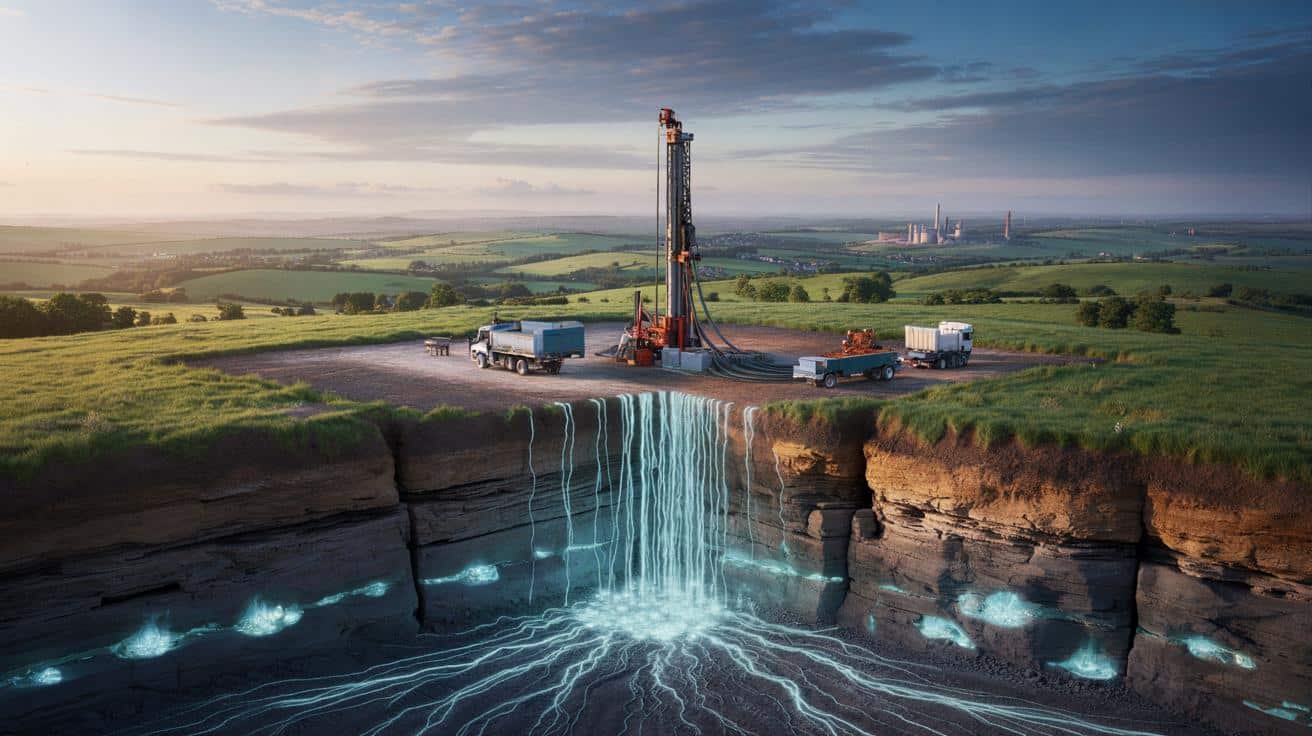
Deep below the former coal basin of Lorraine, researchers are chasing a resource that barely existed in policy documents a decade ago: naturally occurring hydrogen. If their measurements hold up, France’s Grand Est region might be sitting on tens of millions of tonnes of so‑called “white hydrogen” – clean fuel created by the geology itself, not by power‑hungry industrial plants.
From forgotten coal seams to a new hydrogen frontier
The story began in an unexpected way. In 2018, the REGALOR project was launched to look for methane trapped in coal seams in Moselle, near the German border. The aim was fairly classic: confirm earlier estimates suggesting that the old Lorraine mining basin could hold up to 370 billion cubic metres of methane, roughly eight years of France’s gas consumption.
While drilling and sampling those deep formations, researchers stumbled on something else entirely: hydrogen. Not the industrial product of refineries, but hydrogen generated by the rocks themselves and dissolved in deep underground water.
Instead of fossil gas, the drill bits kept bringing back signs of a light, invisible gas pointing to a different energy future.
That surprise shifted the focus. By 2025, the follow‑up programme, REGALOR II, had dropped methane from its agenda. It now concentrates exclusively on natural hydrogen in the Grand Est, with one clear question: how much is really down there, and can it be tapped without replaying the environmental mistakes of the fossil fuel era?
A 4,000‑metre well to test a billion‑euro question
The centrepiece of this effort is the Pontpierre exploratory well in Moselle. Drilling there pushed down to about 4,000 metres, one of the deepest scientific wells in Europe focused on hydrogen. The target is not a classic gas reservoir. It is pressurised water in ancient sedimentary rocks, where hydrogen is present in dissolved form.
Early tests at shallower depths had already raised eyebrows. At around 200 metres, hydrogen made up just 0.1% of the gas mixture – barely notable. Between 600 and 800 metres, that jumped to 1–6%. At 1,100 metres, concentrations above 15% were recorded, levels not seen before in a continental setting.
Modelling now suggests that at 3,000 metres and below, hydrogen content could exceed 90%, hinting at an active factory of gas still running beneath Lorraine.
Based on current data, scientists from CNRS and the University of Lorraine estimate that the broader basin could contain around 46 million tonnes of hydrogen. For comparison, that would equal more than half of today’s global annual production of “grey” hydrogen made from fossil gas, but formed naturally and stored underground.
➡️ If you want beautiful apples, this step is indispensable starting today
➡️ Turning the heating down before going out? It’s probably the worst reflex, here’s why
➡️ No scales needed: the 1-2-2-2 method for foolproof crêpe batter using a single glass
➡️ The judges still can’t believe it: these two French brothers just won the pastry world championship
➡️ Before, My Plants Froze Every Winter – Until I Stopped Throwing Away This Green “Waste”
➡️ A revolutionary therapy could eliminate 92% of cancer cells while preserving healthy tissue
➡️ You’ll Love It: This Miniature South American Fruit Tree Thrives In Pots At Home
How hydrogen is “cooked” inside the crust
One major goal of REGALOR II is to describe this “subsurface kitchen” in detail. The key ingredients are water, iron‑rich minerals, ancient organic matter such as coal, and reactive rocks. At high temperatures and pressures, chemical reactions between hot water and these minerals can split water molecules, releasing hydrogen gas.
Researchers are now trying to pin down four parameters:
- Depth at which most hydrogen is generated
- Types of rocks and minerals that play the leading role
- Temperature and pressure ranges needed
- Pathways through which the gas migrates into deep aquifers
Each rock core, each sample of brine, and each gas measurement from Pontpierre helps build a 3D model of this system. That model matters because it will guide where future wells should go and how far the resource extends beyond the initial test area.
France, the EU and the race for low‑carbon hydrogen
The timing of this discovery could hardly be more strategic. France and the European Union have both committed to net‑zero emissions by 2050. Hydrogen features heavily in those plans, especially for sectors like steelmaking, chemicals and heavy transport that are hard to electrify.
The EU’s Fit for 55 package aims to cut greenhouse gas emissions by 55% compared with 1990 levels. To hit those targets, Europe will need large volumes of low‑carbon hydrogen. Most of the spotlight so far has gone to “green hydrogen,” produced by splitting water with renewable electricity.
Natural hydrogen adds a twist. Unlike green hydrogen, it does not require electricity to create the gas. If it can be extracted with a light environmental footprint, it could complement renewable‑powered electrolysers and reduce dependence on imported energy.
Market analysts already project the global hydrogen business could exceed €190 billion a year by the late 2030s, with every new low‑carbon source competing for a share.
REGALOR II, funded by the EU’s Just Transition Fund and the Grand Est regional government, has a total budget of around €13.3 million. About €1.5 million flows directly to the University of Lorraine and its GeoRessources lab, which coordinates the scientific work.
A tight‑knit consortium on the ground
The industrial lead on the project is La Française de l’Énergie, a company already active on former coal sites. On the scientific and technical side, GeoRessources (University of Lorraine) manages research, BRGM brings national geological expertise, and SOLEXPERTS France focuses on drilling techniques and deep instrumentation.
A multidisciplinary team, GRéSTOCK, sits at the crossroads of geology, chemistry, hydrology and modelling. Their task is to couple the physics of fluid flow with the economics and environmental constraints of a possible future industry.
This collaboration blurs the traditional line between lab science and field operations. Sensors developed initially for fundamental research are already being tweaked for potential industrial use, such as downhole probes that can both measure and selectively extract dissolved gases at great depth.
A new resource, with old fears in the background
For local residents and environmental groups, the question is less about volumes and more about impacts. Moselle still carries scars from mining and from attempts to revive gas production in recent years.
In December 2025, France’s Conseil d’État quashed a licence for coal‑bed methane extraction in the same region, citing unacceptable risk to groundwater. That decision looms over any talk of natural hydrogen production.
REGALOR II explicitly bakes that concern into its mission. Before any commercial move, researchers want to know how pumping hydrogen‑rich water at depth might affect overlying aquifers, and what limits would keep ecosystems and drinking supplies safe.
In the minds of many scientists on site, the project is as much about not repeating past mistakes as it is about pioneering a new energy sector.
Ideas under discussion include closed‑loop systems in which deep water is brought to the surface, degassed, then re‑injected into the same layers, rather than discharged. That kind of approach would aim to keep pressure and flow in balance underground.
White, green, grey: making sense of the hydrogen colour chart
The interest around Lorraine’s white hydrogen comes partly from how it stacks up against other production routes. Industry and policymakers use a colour code to distinguish them.
| Hydrogen type | How it is produced | CO₂ emissions | Current status |
| White hydrogen | Generated naturally underground, often dissolved in deep aquifers | None during formation; extraction impacts still under study | Exploration phase |
| Green hydrogen | Electrolysis powered by renewable electricity | Very low, mostly linked to equipment and grid mix | Early deployment |
| Grey hydrogen | Reforming of fossil gas | High, currently the dominant source | Widely used in industry |
| Blue hydrogen | Grey hydrogen with carbon capture and storage | Lower, but not zero | Pilot projects and first plants |
Today, around 95% of the world’s hydrogen is still grey, used largely in refineries and fertiliser production. Natural and green hydrogen both aim to displace that, but with very different infrastructure needs.
What happens if the Grand Est turns out to be a hydrogen giant?
If the high concentration estimates at depth are confirmed over a wide area, France could face a series of sharp policy choices. One scenario would see Grand Est become a regional hydrogen hub, feeding local industry and neighbouring countries via existing pipeline projects such as mosaHYc, which already links parts of France, Germany and Luxembourg.
That route could cut transport emissions in the Rhine industrial corridor and give heavy industry an alternative to imported fossil gas. Local authorities also see potential for jobs in drilling, monitoring and equipment manufacturing, particularly in areas hit by past mine closures.
Another, more cautious scenario would cap production levels, focusing on long‑term monitoring and environmental safeguards, even at the cost of leaving some of the resource underground. Given recent legal decisions, any permitting process is likely to be slow and contested.
Key concepts for readers watching this space
Two technical terms are worth clarifying for anyone following the debate.
- Aquifer: A rock formation that holds groundwater and allows it to flow. In Lorraine, hydrogen sits dissolved in deep aquifers far below those used for drinking water.
- Redox reactions: Chemical exchanges of electrons between substances. In this case, reactions between water and iron‑rich rocks can free hydrogen as a by‑product.
If natural hydrogen becomes a real industry, risk management will revolve around these two ideas: how to separate deep, mineralised systems from shallow, potable ones, and how to keep those redox processes from being disrupted in ways that trigger earthquakes or contamination.
For now, France stands at a testing point. The drill at Pontpierre has done its job. Over the next few years, the data coming back from labs in Nancy and Paris will decide whether the Grand Est is just a geological curiosity – or the first chapter of a very different European hydrogen story.