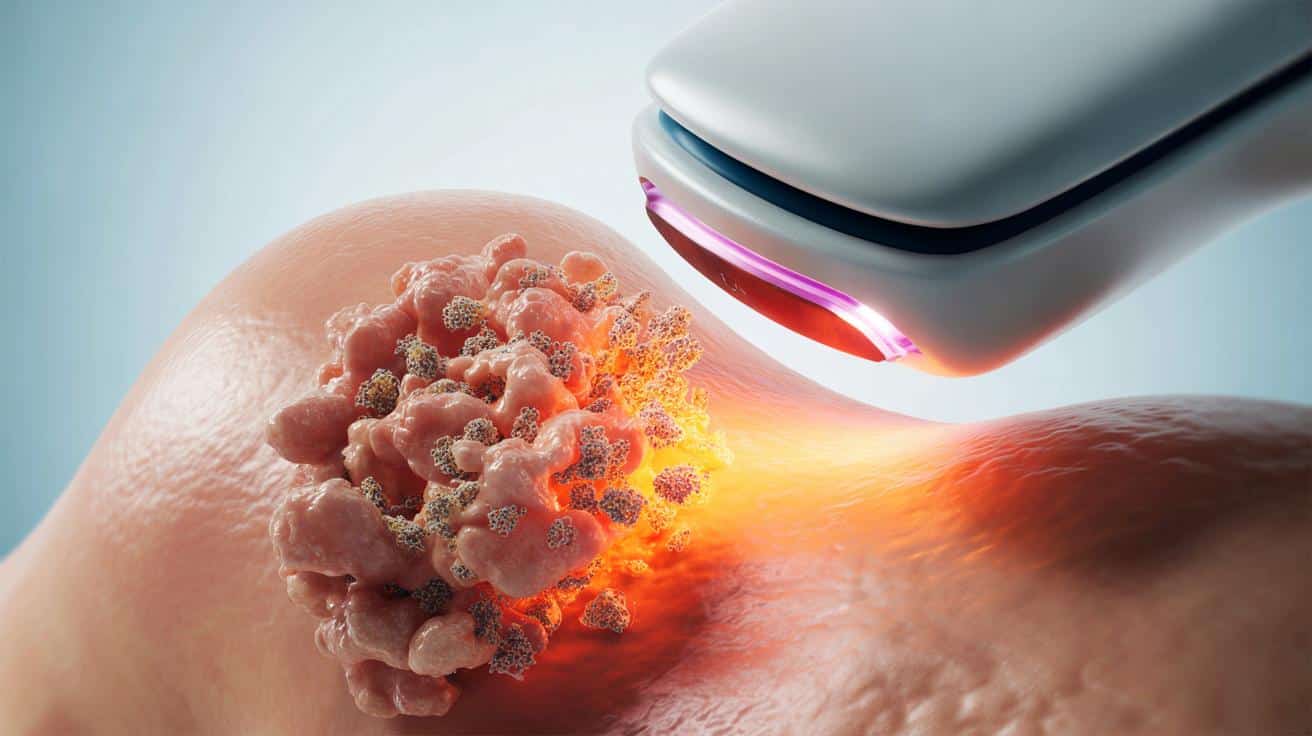
Instead of blasting the entire body, this new approach uses tiny particles and soft near‑infrared light to selectively “cook” tumour cells from the inside, while leaving nearby healthy tissue almost untouched.
A gentler way to attack tumours
For decades, cancer care has relied on harsh tools: surgery, chemotherapy, radiotherapy. They save lives, but they often do it at a high cost, from nausea and hair loss to long‑term fatigue and tissue damage.
Behind the scenes, researchers have been trying to design treatments that can tell friend from foe. The aim is simple to state and hard to reach: destroy cancer cells, spare everything else.
A transatlantic team from the University of Texas at Austin and the University of Porto now reports a step in that direction. In work published in the journal ACS Nano, they describe a light‑based therapy that targets tumours with microscopic particles of tin oxide, then activates them using a cheap near‑infrared LED.
This experimental method wiped out up to 92% of skin cancer cells in lab tests, while leaving surrounding healthy cells largely intact.
The numbers come from early laboratory experiments, not patients, but they hint at a future where some cancers might be treated with a kind of “precision heating” instead of systemic drugs or powerful beams of radiation.
How light and tin team up against cancer
The system relies on two main ingredients: a small, inexpensive light source and specially engineered particles known as SnOx nanoflakes, made from tin oxide and only a few billionths of a metre across.
These particles have a useful quirk. When they are hit by near‑infrared light, they absorb it very efficiently and convert it into heat in a tiny, confined area.
Turning light into lethal heat
In the lab, researchers added the SnOx nanoflakes to cultures of cancer cells. Then they shone near‑infrared light from an LED on the treated cells for 30 minutes. Under the microscope, temperature rose sharply where the particles were present, but stayed relatively low elsewhere.
➡️ You’ll Love It: This Miniature South American Fruit Tree Thrives In Pots At Home
➡️ Here Is The New Pastry Chef Succeeding François Perret At The Ritz
➡️ No scales needed: the 1-2-2-2 method for foolproof crêpe batter using a single glass
➡️ Before, My Plants Froze Every Winter – Until I Stopped Throwing Away This Green “Waste”
➡️ If you want beautiful apples, this step is indispensable starting today
➡️ Turning the heating down before going out? It’s probably the worst reflex, here’s why
Within half an hour, about 92% of skin cancer cells were destroyed. For colorectal cancer cells, the kill rate reached around 50%.
The difference between cancer types suggests that some tumours may be more vulnerable to this method than others. Still, both figures mark a strong effect for a technology at an early stage.
The team, including engineers Jean Anne Incorvia and Artur Pinto, also checked whether repeated heating cycles would damage the particles or blunt their effect. The nanoflakes stayed stable and kept working, an important point for any therapy that might need several sessions.
Why LEDs, not lasers, change the equation
Photothermal cancer treatments are not new. Other research groups have used lasers to heat metallic nanoparticles inside tumours. Lasers, though, bring a long list of practical headaches.
- They are expensive to buy and maintain.
- They need carefully controlled hospital setups.
- Their intense beams can burn or damage healthy tissue.
- They are not suited to simple home‑based devices.
The new approach swaps lasers for near‑infrared LEDs. These are essentially the same type of component found in remote controls or cheap light panels, adapted for medical use.
Using LEDs makes the setup smaller, cheaper and gentler, opening the door to portable, possibly even wearable, devices.
Because the light level is lower and spread over a broader area, the danger to surrounding tissue drops, while the particles themselves focus the heating effect exactly where cancer cells are concentrated.
From hospital wards to home care?
One of the most striking ideas raised by the team is that this therapy might not be confined to big cancer centres. If the technology keeps proving itself, it could fit into compact gadgets designed for outpatient care.
In Portugal, Pinto’s group is already imagining small, handheld or patch‑like devices placed on the skin after surgery. The aim would be to mop up cancer cells that surgeons could not see or remove, without sending the patient back for aggressive treatments.
A post‑surgery LED patch could quietly target lingering cells, lowering the risk of recurrence with minimal disruption to daily life.
That kind of approach would be especially relevant for skin cancers and other tumours close to the body’s surface, where light can reach the treated area without major obstacles.
Which cancers could be targeted first?
The collaboration, funded under the UT Austin Portugal programme, is already looking beyond early tests on cell lines. Priority candidates include:
- Skin cancers, such as certain types of carcinoma, where light access is straightforward.
- Superficial tumours near the skin or body openings, where probes or patches could deliver light.
- Breast cancer, where researchers hope to adapt the method, possibly in combination with surgery or other therapies.
Deeper, hard‑to‑reach tumours may require fibre‑optic tools or minimally invasive procedures to bring light closer to the tin particles. The technology is not yet ready for that, but the basic physics would be the same.
How this therapy fits into modern cancer care
Oncologists rarely rely on just one weapon. A typical patient already faces a mix of surgery, drugs, radiation and, increasingly, immunotherapy. If tin‑based photothermal treatment reaches the clinic, it will likely join that toolkit rather than replace everything else.
One realistic scenario is a “clean‑up” role: surgeons remove the visible tumour, then doctors use the LED‑particle combo to hunt down scattered cells left behind in the tissue margin. Another is to combine mild heating with lower doses of chemotherapy, hoping that cancer cells stressed by heat become more vulnerable to drugs.
| Aspect | Conventional therapy | Tin‑LED photothermal approach (experimental) |
|---|---|---|
| Main action | Targets fast‑dividing cells across the body | Local heating of particle‑rich cancer cells |
| Key tools | Drugs, radiation beams, scalpels | SnOx nanoflakes + near‑infrared LED light |
| Effect on healthy tissue | Often significant collateral damage | Designed to spare nearby healthy cells |
| Care setting | Hospital‑based, highly supervised | Potential for outpatient or at‑home devices |
What patients should know about the risks and limits
For all the excitement, this therapy is not ready for general use. So far, the results come from controlled tests on cells in dishes, not from trials in people. Animal studies and human trials will need to answer practical questions about safety and long‑term effects.
One concern is how the body handles the tin oxide nanoflakes. Researchers will have to show that the particles either stay where they are supposed to stay or can be cleared safely over time. Unintended accumulation in organs would be a red flag.
Doctors will also want to know how precisely the light can be aimed in living tissue, which scatters and absorbs near‑infrared wavelengths. Too little energy, and cancer cells survive; too much, and healthy structures could be harmed.
No one is suggesting patients abandon proven treatments today, but many are quietly hoping for options that hurt less tomorrow.
Some key terms, explained simply
For readers trying to follow the technical language, a handful of concepts sit at the heart of this research.
- Nanoflake: A flat, extremely small particle, only a few nanometres thick. At this scale, materials can gain new optical and thermal properties.
- Near‑infrared light: Light just beyond the red part of the visible spectrum. Human eyes cannot see it, but it can penetrate tissue more deeply than visible light.
- Photothermal therapy: A technique where light is turned into heat at a specific site in the body to damage or kill cells.
Imagine a future appointment where, instead of an infusion that floods the bloodstream, a patient sits under a small panel of near‑infrared LEDs while a previously injected dose of tin nanoflakes quietly heats clusters of cancer cells. Nurses could check the temperature in real time and adjust the light output on the spot.
That scene is still hypothetical, and plenty could change on the path from petri dish to clinic. Yet the principle behind it – using simple light sources and engineered particles to make cancer treatment more precise and less punishing – is already taking shape in labs today.